- Get started
- Learn the Program
On this page

Giving monthly helps us invest in impactful projects. Donate today to help more people live well with MS.
Donate Now
Don’t miss the latest news, tips & resources
Subscribe now MS doesn’t define me: my journey of resilience and creativity
Deanna is an artist based in Melbourne, Australia. She was diagnosed with multiple sclerosis at 17, and initially struggled with her mental and physical health. 18 years later, Deanna is an MS advocate, using creativity and storytelling to challenge assumptions about life with MS.
Giving monthly helps us invest in impactful projects. Donate today to help more people live well with MS.
Donate Now I woke up one morning in the middle of my final year of high school with severe pain in my left eye and was slowly losing vision. It was confusing and frightening, but I brushed it off as a headache and still went to school that day, hoping it would just go away. It rapidly got much worse, and that evening I was rushed from the GP to an ophthalmologist, then to a neurologist the next day.
Hearing the diagnosis at 17 was surreal. I knew little about MS aside from an annual fundraiser, the MS Readathon. I initially thought I was going blind or dying.
This was 18 years ago when the internet was not the beast it is today, so information was really limited. I remember suddenly my future felt uncertain. People tried to limit my potential and, while well-meaning, told me to give up on my schooling and dreams for the future. I remember thinking, “Is this the end of everything I hoped for?” There were so many fears about independence, school, relationships and future disease progression… the whole spectrum of starting my adult life suddenly felt like it was over before it had a chance to begin.
Living with uncertainty after diagnosis
The first few years after my diagnosis were overwhelming, and I experienced a lot of mental health challenges. I didn’t know anyone else with MS, and I carried so many assumptions, like MS would quickly put me in a wheelchair and that my life would be drastically limited. I didn’t think I could travel, pursue higher education, or have healthy relationships.
I struggled to pace myself; while my school peers were out enjoying their lives, I was learning to navigate a disability with little support. I firmly believed no one could love me while living with MS, so I accepted situations that weren’t healthy, which eventually led to an experience of intimate partner violence because I didn’t think I deserved any better. Emotionally, it was a mix of grief, depression, anxiety, and at times, suicidality.
I wrestled with reconciling the life I had imagined for myself with the reality of living with a chronic illness.
A conversation that changed everything
When I was 20, I had a chance encounter with a doctor. I told her I felt like I couldn’t lead a “normal” life or do much with myself because of my MS. She matter-of-factly told me that she also had MS, but her MS was invisible (which I hadn’t realised was even possible). She then cleared the next 30 minutes for me to ask any questions.
Looking back, my questions probably sounded stupid: How did she become a doctor? How did she apply to university? How did she have a loving partner, respect herself, and not let MS define her worth? That one conversation blew my mind wide open. I left that day and immediately started Googling ways to get into university, and by the next semester, I had enrolled. Honestly, that conversation saved my life. In later years, I’ve spoken widely about the power of diverse representation and the impact it can have.
After that encounter, I started seeing that life with MS didn’t have to be defined by limitations. I connected with MS organisations and several years later became the advocate I wish I had when I was first diagnosed.
Embracing lifestyle choices
Today, I use modifiable lifestyle factors alongside my disease-modifying therapy to stay well. Small lifestyle choices, such as exercise, stress management, creative outlets and nutrition, all make a huge difference and help me feel more in control. Some days, MS still feels overwhelming, unpredictable and scary. I still experience what I call the “spicy sads” in terms of my mental health, but over time, I’ve learned strategies to navigate symptoms while still living a good life.
Alongside these lifestyle choices, humour has been a huge tool in my toolkit, along with staying active in my treatments and finding my “MS squad”. For me, realising that MS was not going to define me was life-changing. While MS may create roadblocks, I’ve learned there are always workarounds, big and small.
Turning MS into creativity
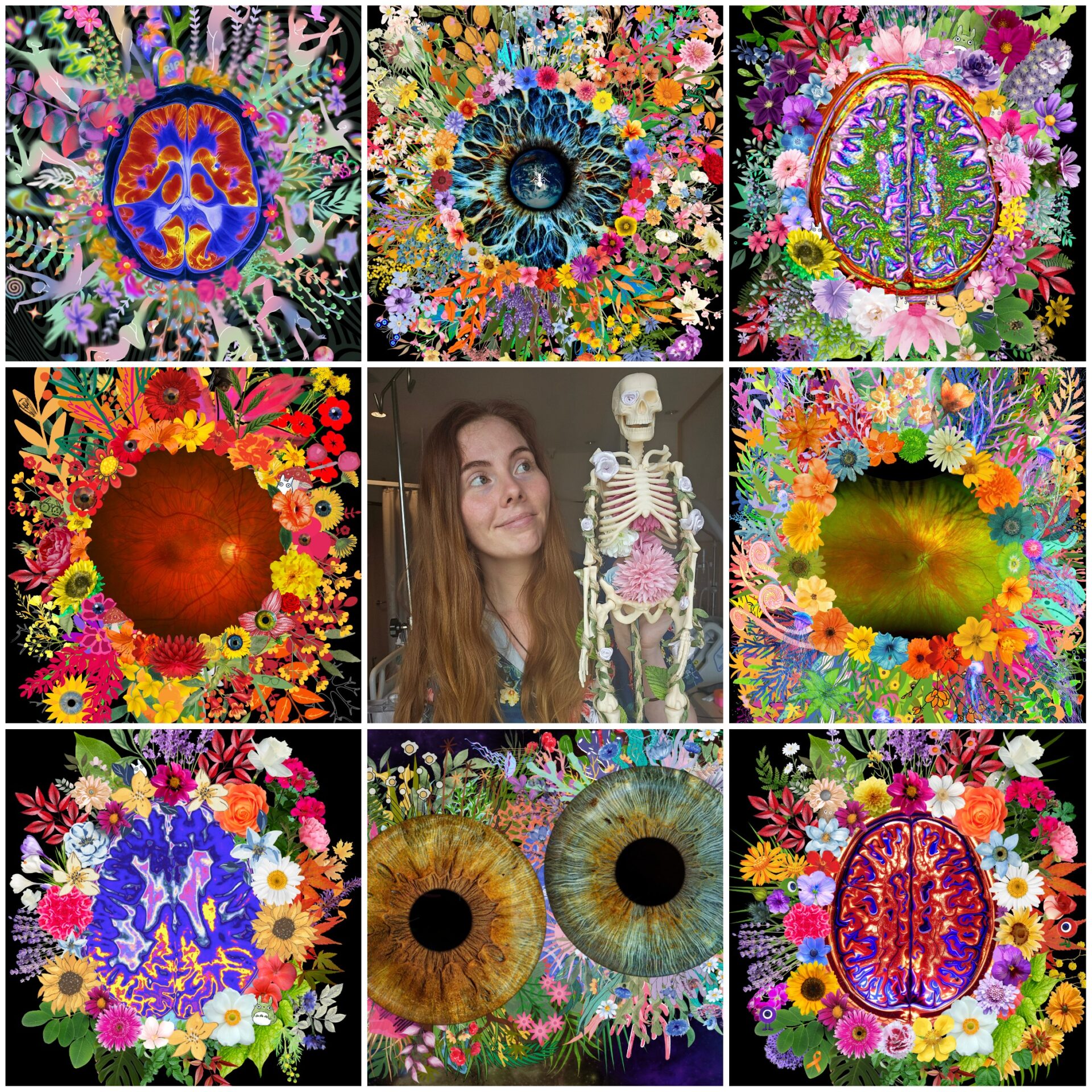
I used to be a little obsessed with looking at my black-and-white MRI scans, trying to count the lesions and letting fear take over. It wasn’t a healthy habit, and it fed a lot of my anxiety. During one hospital admission, I saw an anatomical skeleton covered in flowers, and the idea bloomed that things could still be clinical while also being beautiful. I started surrounding my MRI scans with flowers, and art quickly became my way of making sense of my experience with MS. Turning MRI imagery and lived experience into visual storytelling allowed me to process, express and connect with others in ways that words sometimes can’t.

Artwork © Deanna Renée/CircularBlooms
Creativity gives me freedom to transform the challenges of living with MS into something expressive and colourful. Through my work, I hope people can see the possibility: that changing perspective can ultimately change realities. Chronic illness doesn’t have to limit imagination, purpose, or joy; it can inspire new ways of seeing, being and creating. As I often say, you have to grow through what you go through, and that is why I created CircularBlooms.
Life with MS can be vibrant, colourful, creative and meaningful
If I could speak to someone who was just diagnosed, I’d say: MS is a diagnosis, but it doesn’t have to define who you are. There will be hard days, the uncertainty, the impacts on your sense of self are very real, but your future is still full of possibility. Surround yourself with people who listen, connect with your local MS organisation and explore ways to support your body and mind.
Those small lifestyle choices can really make a big difference. Separate the hype from the help, avoid googling everything on the day of your diagnosis and don’t let assumptions define what your life will look like. And finally, tell your story; if sharing your story helps even one person realise that life with MS can still be vibrant, colourful, creative and meaningful, it’s absolutely worth it.
MS: A diagnosis, not a destiny
Deanna shared her story to raise awareness of the role of lifestyle choices in managing MS.
If you want to know more about healthy lifestyle choices, and what the evidence really says take our quiz or read our report here.
If anything in this story has affected you, support is available. You can contact Samaritans or find other helpful resources here: Resources for Managing Your Mental Health with MS | Overcoming MS.
Further Reading
- Learn the Program