- Get started
- Learn the Program
On this page

Giving monthly helps us invest in impactful projects. Donate today to help more people live well with MS.
Donate Now
Don’t miss the latest news, tips & resources
Subscribe now Challenging assumptions: running the London Marathon with MS
This MS Awareness Week, we’re challenging assumptions about multiple sclerosis. After being diagnosed, Sarah assumed her active life would have to change. Now, she’s on the start line of the London Marathon, proving that MS doesn’t always limit what’s possible.
Giving monthly helps us invest in impactful projects. Donate today to help more people live well with MS.
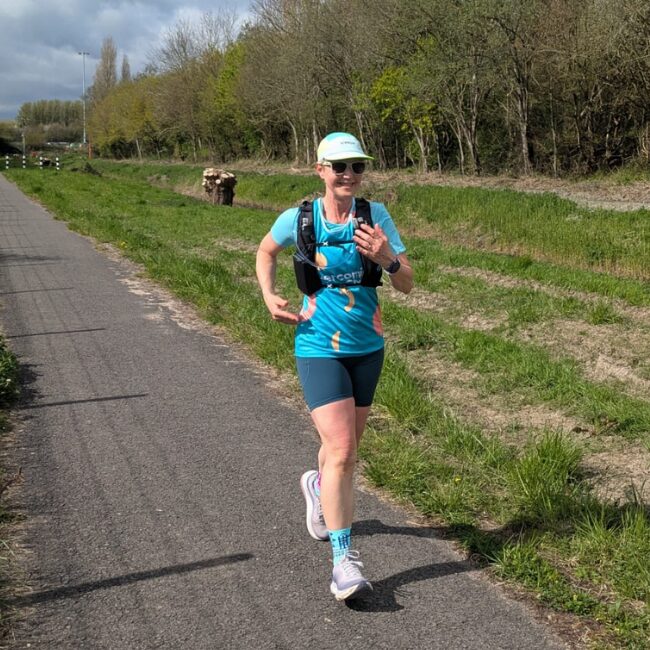
Donate Now I’m Sarah, and on Sunday 26 April I’ll be standing on the start line of the London Marathon – something I never thought I’d be able to say after my MS diagnosis.
Just over 13 years ago, I vividly remember sitting in a hospital room in France, where I was undergoing tests to discover the reason for the sudden onset of double vision and dizziness that had started a few days previously. When I asked the consultant for his thoughts as to the cause, he said ‘sclérose en plaques’, I didn’t understand the French term, but when I realised that it meant multiple sclerosis, I didn’t know what to say. It came as a complete shock to me.
He had said it in such a matter of fact way, with no drama, not appreciating what effect hearing those words could have on me.
Before diagnosis: My assumptions about MS
The news that I might have MS took me completely by surprise, how could I have MS? I was fit and healthy and never ill. However, looking back, there had been signs that something was not quite right in the months leading up to that first relapse. I had had occasional dizzy spells; I had become slightly clumsy and sometimes walked into things. I realised that I didn’t know much about MS, and didn’t know anyone with MS. The only person I’d heard of who’d had MS was Jacqueline Du Pré.
Like many people, I had assumptions about what MS would mean for my future. Given how much I loved sport, one of my first thoughts was that my mobility would be seriously affected. Maybe I could train to take part in a paralympic event or perhaps compete in the wheelchair London Marathon? I felt my life as I knew it would have to change.
Challenging assumptions through lifestyle
After my diagnosis, I started looking for answers: reading, researching and trying to understand what MS might mean for me. The more I learnt about MS in those early days, the more I began to become more hopeful that my assumptions were wrong, and I might still be able to lead an active life. First of all, I came across the pioneering work of George Jelinek and the Overcoming MS Program. I was immediately drawn to this as it fitted in with my own philosophy of self-management. I was a Pilates teacher, and the principles of Pilates matched this approach, particularly the ‘mind body’ aspects and the ‘control’.
I was also inspired by an American Pilates teacher, called Mariska Breland, who was living and teaching Pilates with MS, I later trained with her to learn more about Pilates and MS.
“You don’t look like you have MS”
In the early months, I was unsure what path my MS was going to take. I didn’t know whether I was going to be able to work, if or how often I was going to have relapses. At the time, I was running my own business teaching Pilates in France. All the students in my classes knew I’d had to cancel classes for several weeks and that I’d been hospitalised, but once I started teaching again, I didn’t widely share my diagnosis. Not because I wanted to hide it, but because having ‘recovered’ after that initial relapse, I could still teach, and it didn’t seem necessary to tell them. If people explicitly asked me, I did share my diagnosis, and they were generally genuinely shocked, as my teaching Pilates didn’t fit in with their pre-conceived ideas of what MS looks like. In order to get back to being able to teach again, I had worked hard, particularly on my balance and strength; this is something I continue to do.
I realise that outwardly, it might not be obvious to people that I have MS, which I know in some ways is a good thing, but as we know, MS affects people in many different ways, and many of the symptoms are not always visible. Personally, I experience neuropathies down my right side and I have issues with my bladder and bowel. I am prone to mood changes as well as to fatigue. Recently, I have had a few really bad episodes of vertigo too.
Running the marathon I assumed wouldn't be possible
My decision to enter the London Marathon came about last year, having moved back to the UK and joined a local running club. I had taken up running a few years before having had a break for over 20 years. After talking to a fellow OMSer, Véronique, who ran the London Marathon last year, I applied and subsequently managed to get a place through the disability ballot. As places are like gold dust, I decided to use the opportunity to fundraise for Overcoming MS.
For the last 9 months I have been following a training plan for the marathon, that started with building up to 5k, then 10 k, and by Christmas, I was running as far as 16k (10 miles). The longest run I have done in my training was a couple of weeks ago, when I ran 32k (20 miles). Due to an arthritic toe, I was advised to only run on 3 days a week, and to cross-train on a stationary bike and do strength training in addition to my normal Pilates practice.
I have mostly stuck to my plan, but there have been a few occasions where I’ve had to make changes. Just a few weeks ago, I fell over a dog that ran in front of me, landing heavily on my knee. As well as injuring my knee which meant resting for a few days and substituting a few runs with cycling on a static bike, the fall really shook my confidence and left me sobbing on a bench.
There have also been times when my fatigue has got the better of me and I’ve had to make changes for that day; for example, instead of going out on a run, I’ve done a bike session instead, so that I know I can stop if I really need to. Although at other times, I have made myself go out and set myself a goal of 10 minutes. If I still feel bad I stop, but more often or not, being outside has helped and I manage to overcome the fatigue. I’ve also had to try to find strategies to deal with the neuropathies in my right foot and down my right arm and leg. There used to be a Tour de France cyclist Jens Voigt, who was renowned for his physical and mental toughness and his long stints cycling at the front of the Peloton, he said he would repeat to himself, ‘shut up legs’ when his legs were screaming at him to stop!
Issues with my bladder and bowels still worry me a bit for the day of the Marathon itself, but I have familiarised myself with the course, I know there are toilets en route and I have my ‘Just Can’t Wait’ card if necessary.
To be able to train for the London Marathon means a great deal to me, and I have been keeping a journal as well as posting about my progress on social media. One of the proudest moments so far in this journey has come from a couple of fellow MSers who have contacted me to say that they have been inspired by what I am doing, and it has encouraged them to continue with the running that they’re doing. One of them even said she too, was thinking about entering the Marathon.
I’m running this race for me, but also for everyone who has had an MS diagnosis and is sitting with the same fear I once felt.
I don’t know yet what will happen on the day, but I feel proud of what I’ve achieved in my training and confident that I’ve done all that I can to prepare. What I do know is that thirteen years ago, I assumed MS would limit my life. Now, I’m running a marathon.
By supporting Sarah’s London Marathon challenge, you’ll be helping Overcoming MS continue to support people living with MS. You can donate to her JustGiving page here: Sarah Johnson is fundraising for Overcoming Multiple Sclerosis
Further Reading
- Learn the Program